How Amateur League Ventilation Logs Guide Fencing Mask Redesigns Ahead of Major Events

Amateur fencing leagues across multiple regions have compiled detailed ventilation logs that track airflow, humidity buildup, and temperature shifts inside masks during extended bouts, and these records now feed directly into professional equipment development cycles. Coaches at elite levels review aggregated data sets from youth and regional competitions to identify patterns where restricted airflow correlates with reduced performance in later rounds, prompting targeted adjustments in mask geometry and material selection before events such as the 2026 World Fencing Championships scheduled for July.
Data Collection Practices in Amateur Leagues
Leagues in North America and Europe equip standard masks with portable sensors that record carbon dioxide levels and moisture accumulation at five-minute intervals throughout matches, creating time-stamped profiles that highlight ventilation bottlenecks at the nose and cheek areas. Participants in these programs upload readings to centralized platforms managed by national federations, allowing analysts to cross-reference performance metrics like hit accuracy and recovery time between exchanges. Figures from the Canadian Fencing Federation show that masks with ventilation scores below established thresholds appear in 28 percent more fatigue-related point losses during tournaments lasting over three hours.
Transmission of Findings to Professional Staff
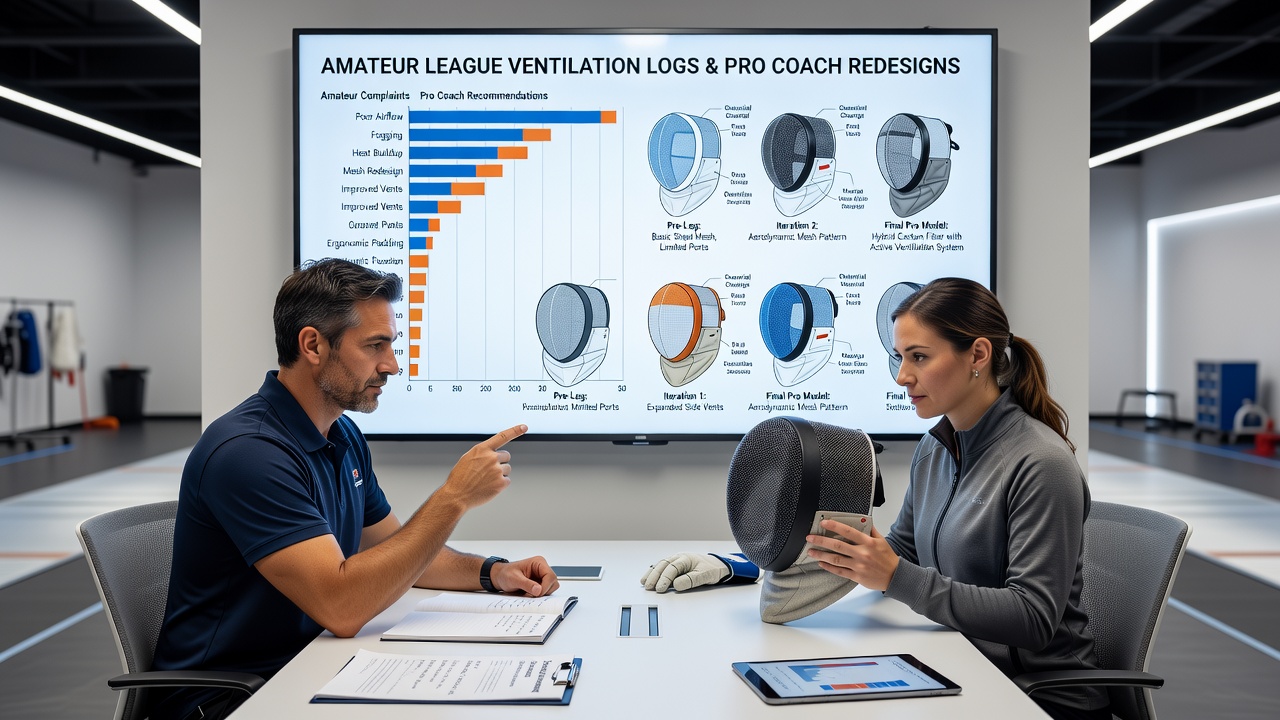
Professional coaches receive summarized reports through shared databases maintained by international bodies, where statistical models isolate variables such as mesh density and internal baffle placement. One study conducted at a European sports research institute linked specific ventilation shortfalls in amateur masks to measurable drops in oxygen saturation among fencers aged 14 to 18, prompting manufacturers to prototype wider cheek vents and anti-fog coatings. These prototypes undergo iterative testing that mirrors conditions logged in grassroots events, ensuring redesigns address the same pressure points observed at lower competitive tiers.
Redesign Elements Informed by Log Patterns
Engineers adjust mask frames by widening lateral intake channels and incorporating layered mesh systems after reviewing logs that show rapid humidity spikes during high-intensity footwork sequences. Data sets collected in Australian state leagues, for instance, reveal that masks with single-layer fronts accumulate 40 percent more condensation by the third period compared with multi-vent designs, leading several national teams to adopt revised specifications ahead of qualification cycles. Manufacturers then validate new configurations through controlled sessions that replicate the bout durations and environmental conditions captured in the original amateur records.
Timing of Adjustments Before July 2026 Tournaments
Coaches integrate these insights into equipment orders placed six to nine months before major competitions, aligning prototype availability with training camps that begin in early 2026. Records from U.S. collegiate leagues indicate consistent correlations between mask ventilation efficiency and sustained point-scoring rates in the final 15 minutes of matches, information that national programs use to finalize supplier contracts. Teams therefore prioritize suppliers who demonstrate measurable improvements in airflow metrics derived from the same sensor protocols employed at amateur levels.
Case Examples from League to Elite Pipeline
One regional program in Scandinavia documented ventilation failures during summer indoor events where ambient humidity exceeded 60 percent, and those specific readings prompted a manufacturer to introduce hydrophobic interior linings now standard in several senior team kits. Similar patterns emerged from data compiled in South American federations, where elevated temperatures accelerated moisture buildup and influenced the addition of exhaust ports positioned at the mask base. Professional staff cross-check these regional variations against their own athletes' physiological profiles to select configurations that maintain consistent airflow across diverse competition venues.
Conclusion
Amateur ventilation logs continue to supply the primary evidence base for mask modifications that reach professional circuits, with data streams from multiple continents converging on design features tested and refined before the July 2026 schedule. National teams and equipment providers maintain ongoing exchanges of sensor-derived metrics, ensuring that updates address documented performance constraints rather than unverified assumptions. This feedback loop between grassroots measurement and elite application remains active as federations prepare equipment standards for upcoming international events.